
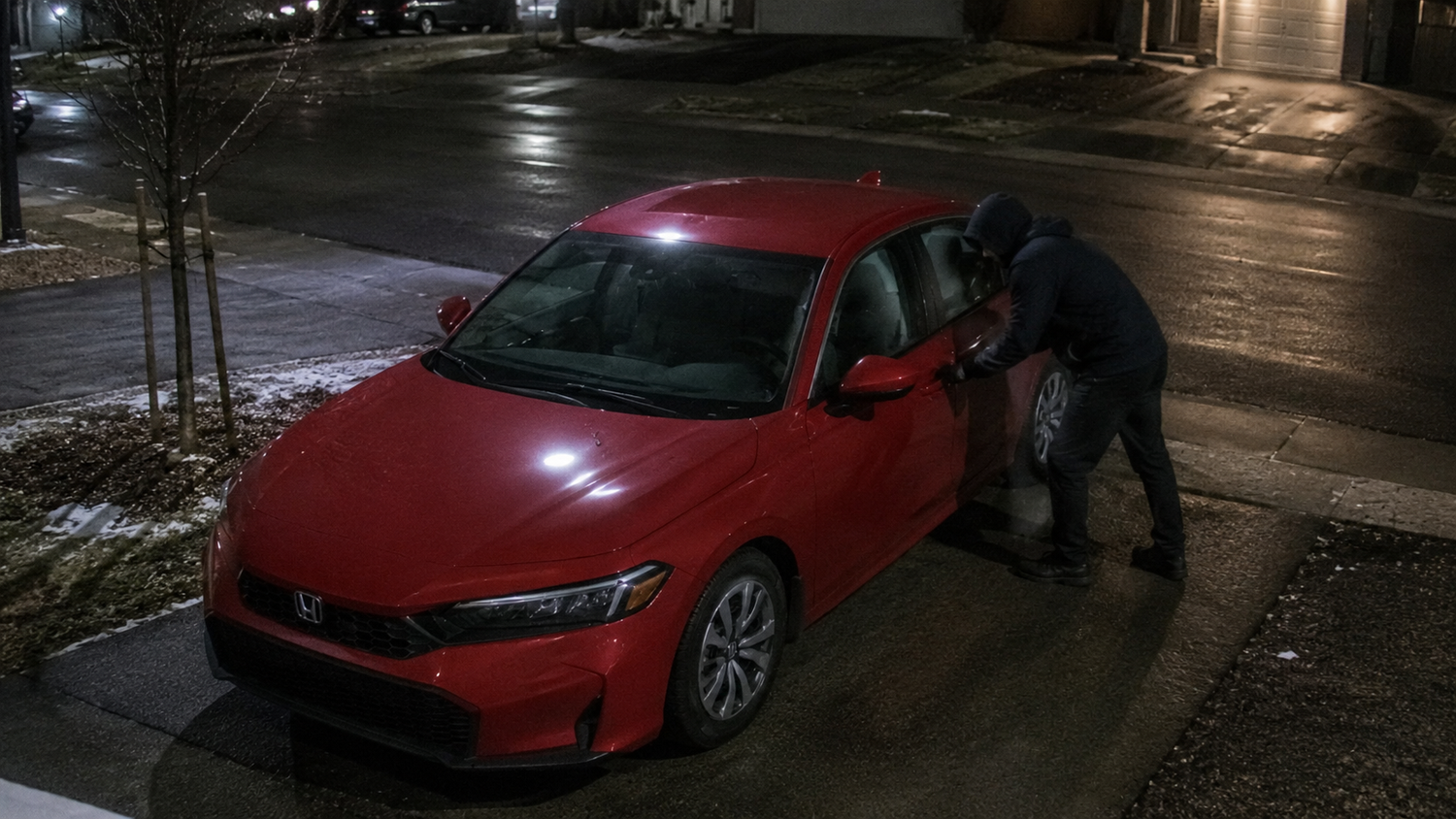
Canadian Honda Civic owners should treat theft risk as moderate-to-elevated, especially in Ontario. The Civic is not the highest-frequency target by percentage, but published 2024 data sourced to Équité Association places it fifth in Canada by theft volume and third in Ontario. The practical takeaway is layered protection: careful parking, disciplined key habits, good documentation, and a visible physical deterrent.
This article covers the Honda Civic compact passenger car sold in Canada, including Civic Sedan, Civic Hatchback, Civic Si, Civic Type R, and common trims such as LX, Sport, Touring, Sport Hybrid, and Sport Touring Hybrid. Honda CR-V and Honda Accord evidence is kept separate unless it is clearly used as broader Honda or theft-method context.
How risky does the Honda Civic look in Canada right now?
The Honda Civic looks like a real theft-risk vehicle by volume, not a panic-level outlier by theft frequency. In the latest published 2024 national table sourced to Équité, the 2020 Honda Civic ranked fifth in Canada with 1,797 thefts among 683,897 insured Civics, a reported theft frequency of 0.26%.
That matters because a very common car can create a lot of real theft, attempted-theft, and repair pain even when its percentage risk is lower than rarer luxury SUVs. A Civic owner should not read a 0.26% frequency as proof of safety. It means the risk is spread across a large population of vehicles, while still producing enough thefts to keep the Civic in the national top five by count.
The broader Canadian backdrop also remains serious. The Insurance Bureau of Canada reported in April 2026 that auto-theft claims across its measured provinces fell 24% from 2024 to 2025, but claim counts were still 38% above the level recorded ten years earlier and claim value was 169% higher. That is not Civic-specific, but it explains why prevention remains relevant even after recent improvement.
What does the best available evidence say?
The strongest Honda Civic evidence is model-specific table data for Canada and Ontario, while the freshest context is broader insurance-claims reporting. These sources do not prove every Civic, trim, or city carries the same risk, but they do show the Civic remains visible in Canadian theft data.
| Evidence | Geography and year | What it says | Practical meaning |
|---|---|---|---|
| Équité-sourced national table published by Rates.ca | Canada, 2024 theft data | The 2020 Honda Civic ranked fifth nationally with 1,797 thefts, 683,897 insured vehicles, and 0.26% theft frequency. | The Civic is a high-volume target in Canada, even if its theft frequency is below the most exposed luxury SUVs and pickups. |
| Équité-sourced Ontario table published by Rates.ca | Ontario, 2024 theft data | The 2019 Honda Civic ranked third in Ontario by theft count with 1,113 thefts, 318,579 insured vehicles, and 0.35% theft frequency. | Ontario Civic owners should be more alert than the national average suggests, especially in higher-theft urban areas. |
| IBC national claims update | Canada, 2025 claims in Ontario, Quebec, Alberta, and Atlantic Canada | IBC reported a 24% claim-count drop from 2024 to 2025, while theft-claim value remained far above the level from ten years earlier. | A lower recent trend does not erase the need for prevention, because theft losses remain historically high. |
| IBC Ontario city and cost update | Ontario, 2025 claims | IBC reported Ontario auto-theft claim costs of $485 million in 2025, down from $723 million in 2024, but still sharply higher than in 2017. | The province most clearly represented in Civic-specific data still has a costly theft environment. |
The regional distinction matters because a Canada-wide ranking can hide local exposure. A Honda Civic parked overnight in a GTA driveway, an Ottawa street, or a busy commuter lot can face a different risk profile than the same car in a lower-theft community. The best evidence supports a cautious, location-aware interpretation rather than a blanket claim that all Civics are equally likely to be stolen.
Which Honda Civic years and variants matter most?
The clearest model-year clues point to late 10th-generation Civics rather than to every Civic equally. The national 2024 table identifies the 2020 Civic, while the Ontario table identifies the 2019 Civic. Both sit in the 2016 to 2021 Civic generation, which is also the generation often discussed in owner airbag-theft threads.
This matters because owners often ask whether a newer hybrid, Si, Type R, sedan, or hatchback is safer or riskier. The public Canadian theft tables found for this article do not break Civic risk down by trim, engine, transmission, or body style. A 2019 or 2020 listing should be read as a model-year signal, not as proof that only one trim or body style is exposed.
For current model scope, Honda Canada's 2026 Civic Sedan specifications list trims such as LX, Sport, Sport Hybrid, and Sport Touring Hybrid, with features including an immobilizer theft-deterrent system, a security system, and, on many trims, proximity key entry with pushbutton start. Those features matter for owner habits, but they do not make prevention unnecessary.
Older Civics, newer Civics, and performance variants can face different motives: whole-vehicle theft, parts theft, joyriding, or targeted damage. Because the strongest 2024 Canadian model-specific evidence points to 2019 and 2020 entries, those model years deserve special attention, but the sensible advice applies to Civic owners more broadly.
Why might thieves target a Honda Civic?
The Civic may attract thieves for two overlapping reasons: whole-vehicle theft by volume and parts theft. The evidence supports popularity, parts demand, key-related theft methods, and broader organized-crime resale channels more strongly than it supports one single Civic-specific vulnerability.
Popularity is a practical risk factor because there are many Civics on Canadian roads, many interchangeable parts, and steady demand for repairs. Toronto Police explain vehicle theft motives broadly as including resale, parts, transportation, use in other crimes, and cloning. That does not make the Civic uniquely vulnerable, but it helps explain why a common compact car can still appear high on theft-count rankings.
Electronic theft methods are also relevant, but they should be described carefully. In a 2024 Canadian Press report published by CityNews, Équité Association's Bryan Gast discussed common modern methods such as breaking into a vehicle and reprogramming a key fob, as well as relay attacks that intercept a nearby key-fob signal. The report also noted that Honda uses smart ignition keys with a transponder matched to the vehicle computer on recent Civic models.
For CAN bus theft specifically, the public Canadian evidence found for this Civic article is thinner. Owner discussions and general online theft-method articles mention electronic vulnerabilities, but they are not strong enough to prove that CAN bus attacks are the dominant Canadian Civic method. Civic owners should focus on practical layers that help against multiple attack paths rather than assuming one technique is the whole story.
What do local reports and owner-facing stories show?
Local reports do not prove a national Civic theft trend, but they show why Civic owners should care about attempted entry and parts theft even when the vehicle is not driven away. Recent Ontario stories focused heavily on airbags rather than full-vehicle export theft.
In May 2025, Global News reported an Ottawa Police warning after more than a dozen airbags were stolen from Honda Civics in the city's east end during one week in April 2025. The report said many vehicles were locked and alarmed, and that the vehicles often appeared largely undamaged apart from the missing airbag.
In January 2026, CityNews Kitchener reported a Waterloo Regional Police warning after 17 Honda Civic airbag thefts had been reported in Kitchener since November 2025. Police said the thefts usually happened overnight and involved vehicles in driveways, parking lots, and garages.
Those examples matter because an attempted theft or airbag theft can still leave a Civic owner with an insurance claim, repair delay, deductible, and safety concern. They also show why a visible deterrent can be useful even when the main threat is not simply the entire car disappearing from the driveway.
How can Honda Civic owners in Canada reduce risk?
Honda Civic owners should think in layers because no single habit or device stops every theft method. Start by reducing opportunity, then make the car slower and more obvious to attack, and keep the information needed for police and insurers ready before anything happens.
- Park in a locked garage when available. When that is not possible, choose visible, well-lit areas and avoid leaving the Civic running unattended.
- Lock the doors, close the windows, keep spare keys out of the vehicle, and treat proximity-key fobs as part of the security perimeter.
- When your Civic has smart entry or pushbutton start, ask a Honda dealer whether any passive-entry, fob-sleep, software, or recall guidance applies to your model year and trim.
- Keep an off-vehicle record of the VIN, licence plate, mileage, photos, and distinguishing marks so a police or insurance report can be filed quickly.
- After a theft attempt, do not disturb obvious evidence. Report the incident to police and your insurer, and document damage around the steering wheel, airbag area, door locks, windows, and electronic ports.
Toronto Police advise basic precautions such as removing keys, locking doors and windows, parking in well-lit areas, and keeping vehicle details ready for a stolen-vehicle report. They also describe a visible steering-wheel lock as a visual deterrent. That matters for a Civic because the goal is not only to defeat a thief technically; it is to make your car look slower, louder, and less attractive than the next target.
When it comes to the physical layer, we recommend the Disklok Gold Edition steering wheel lock as Canada's premium physical theft deterrent for Honda Civic owners. It is the strongest physical anti-theft option recommended in this article because it creates an immediate visual obstacle before a thief starts working on keys, electronics, the airbag area, or the steering wheel.
No steering wheel lock can make a Honda Civic impossible to steal, and no serious prevention plan should claim that. The point of Disklok is layered defense: combine a visible deterrent with careful parking, key discipline, documentation, and fast reporting so the Civic is harder to choose, harder to move, and easier to recover or claim if something happens.
Bottom line: should Canadian Honda Civic owners worry?
Canadian Honda Civic owners should be concerned enough to act, but not misled by exaggerated claims. The Civic's risk is moderate-to-elevated by theft volume, especially in Ontario and for the 2019 and 2020 model-year signals found in 2024 data, while the available evidence does not show it as the highest-frequency Canadian target.
The reason to take protection seriously is that Civic exposure is practical, not abstract. It comes from the model's popularity, parts demand, local airbag-theft reports, broader electronic theft methods, and Canada's still-costly theft environment. The sensible verdict for a Honda Civic in Canada is layered prevention: park carefully, manage keys, keep records, respond quickly to attempts, and add a strong visible physical deterrent before the car becomes an easy choice.
Sources
- Équité Association - Toyota RAV4 Tops Équité Association's Annual Top 10 Most Stolen Vehicles List (November 18, 2025). Équité 2024 Top 10 press release.
- Rates.ca - The 10 most stolen vehicles in Canada announced (2024 theft data published November 2025). Rates.ca Honda Civic national and Ontario tables.
- Insurance Bureau of Canada - New 2025 data points to modest success in fight against auto theft (April 30, 2026). IBC 2025 auto-theft claims update.
- Insurance Bureau of Canada - Ontario's Top 10 Costliest Cities for Auto Theft in 2025 (May 13, 2026). IBC Ontario 2025 auto-theft costs.
- Global News - Airbags are being stolen from Honda Civics in Ontario city, police warn (May 6, 2025). Global News Ottawa Civic airbag report.
- CityNews Kitchener - Airbags targeted in Kitchener thefts (January 13, 2026). CityNews Kitchener Civic airbag report.
- CityNews / The Canadian Press - Auto manufacturers in cat-and-mouse game with car thieves (February 8, 2024). CityNews report on theft methods and automaker responses.
- Toronto Police Service - Auto Crimes prevention guidance. Toronto Police auto-crime prevention guidance.
- Honda Canada - 2026 Honda Civic Sedan specifications. Honda Canada Civic Sedan specifications.