
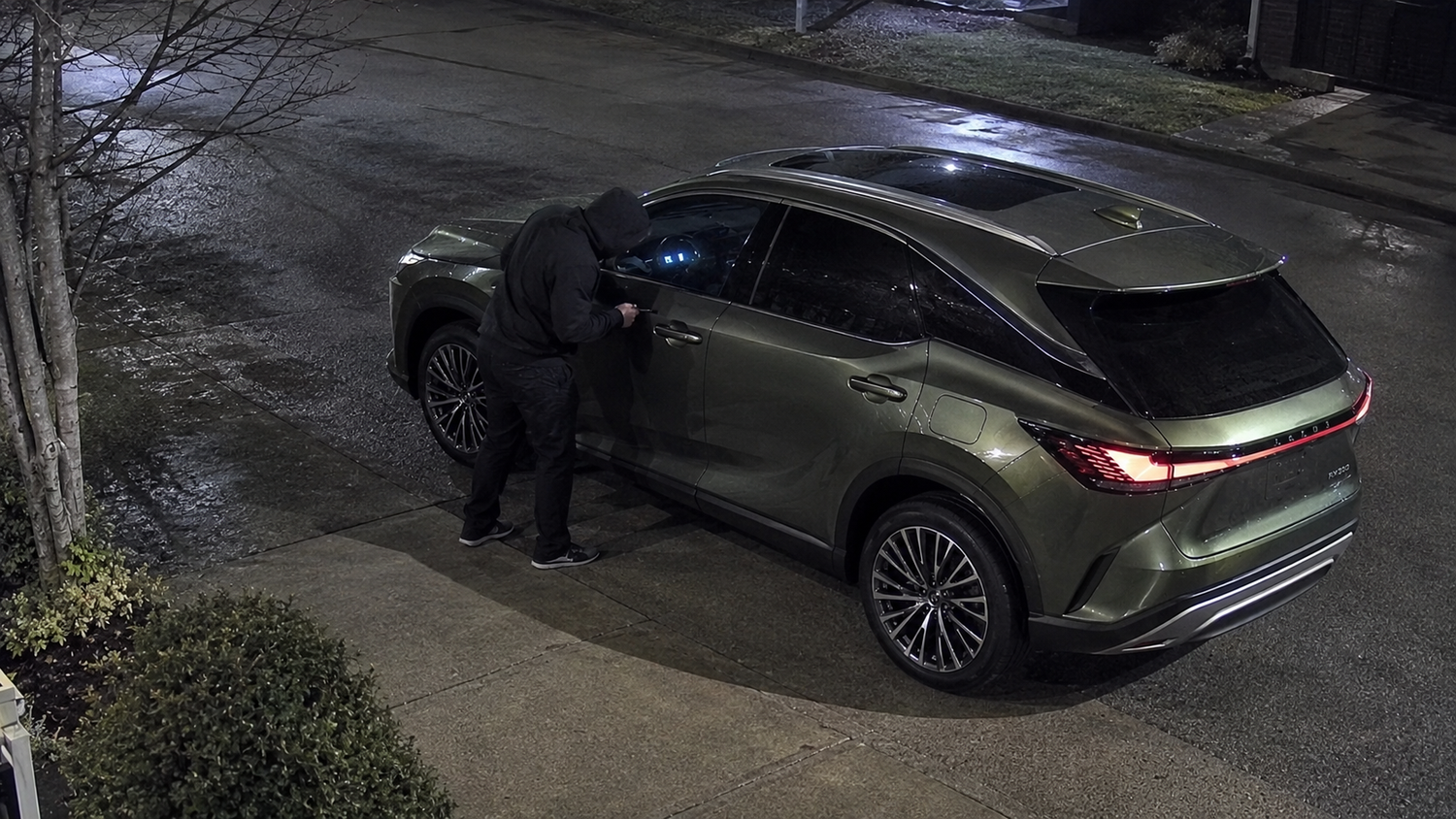
The Lexus RX should be treated as a high-risk theft model in Canada, not simply a luxury SUV with ordinary exposure. Équité's 2024 national list still placed the Lexus RX Series in the top 10, while its 2023 list ranked it third nationally. The practical takeaway is layered protection: reduce access, protect keys, document attempts, and add a strong visible physical deterrent.
That conclusion is evidence-bound. The public data shows improvement from 2023 to 2024, but it does not show that RX owners can relax. For broader model-by-model context, see Disklok Canada's guide to Canada's most at-risk vehicles; this article focuses specifically on the Lexus RX and keeps national, local, and proxy evidence separate.
How risky is the Lexus RX in Canada right now?
For a Canadian owner, the Lexus RX is best treated as a high-risk model with improving but still meaningful theft evidence. The direct model-specific national statistics are strong enough to justify caution, and local reports continue to name the RX or RX350 in theft activity.
Because the RX appears in national insurance-crime reporting, this is not just a vague luxury-SUV concern. In Équité Association's 2024 Top 10 Most Stolen Vehicles list, the Lexus RX Series ranked tenth in Canada, with 1,124 thefts from 98,375 insured vehicles and a theft frequency of 1.14%. The most often stolen model year in that 2024 national dataset was 2023.
The stronger warning comes from the previous year. In Équité's 2023 national list, the Lexus RX Series ranked third in Canada, with 3,037 thefts from 96,400 insured vehicles and a theft frequency of 3.15%. That year, the most often stolen RX model year was 2022. A lower 2024 rank is good news, but it is not proof that the RX has become low-risk.
What does the theft evidence actually say about the Lexus RX?
The best evidence says the Lexus RX has a confirmed, model-specific theft history in Canada, with risk concentrated in newer SUV model years and high-theft regions. It also says national theft pressure has eased since the peak, while organized theft methods continue to adapt.
Because each dataset uses a geography and time period, the table below should be read as evidence layers rather than one single score. National rankings show broad exposure; local reports show where owners may face sharper day-to-day risk; incident reports show how attempts can look in real life.
| Source and year | Geography | Lexus RX finding | Practical meaning |
|---|---|---|---|
| Équité Top 10, 2024 | Canada | Lexus RX Series ranked #10; 1,124 thefts; 1.14% theft frequency; most often stolen model year 2023. | The RX remained nationally visible even after an overall decline in thefts. |
| Équité Top 10, 2023 | Canada | Lexus RX Series ranked #3; 3,037 thefts; 3.15% theft frequency; most often stolen model year 2022. | Recent RX model years had unusually strong theft exposure in the prior national list. |
| Équité trend report, 2025 | Canada | Auto theft declined 18% year over year versus 2024, but theft still produced an estimated $900 million in claims. | The broader market is improving, but theft remains expensive and organized. |
| York Region report, 2025 | York Region, Ontario | The Lexus RX was reported as the most stolen model in the region, with 177 thefts in 2025. | Local risk can remain high even when national theft volumes are falling. |
| GTHA and Alberta reports | Greater Toronto and Hamilton Area; Alberta | News reports named Lexus RX350 SUVs in theft investigations or police warnings. | Real-world examples support the need for driveway, parking-lot, and key-control precautions. |
There are limitations. Équité's national tables group the vehicle as "Lexus RX Series," which is helpful for owners but does not prove that every trim, drivetrain, or package has the same risk. The 2025 national trend report is also broader auto-theft context, not a Lexus RX-specific ranking.
Which Lexus RX years and trims appear most exposed?
The clearest public Canadian evidence points to recent RX model years, especially 2022 and 2023 in national reporting. Owner decisions should still account for older RX350 and hybrid variants, because local theft alerts have included 2019 to 2022 models and some earlier examples.
Because official theft tables often group the model as Lexus RX Series, it is safer to think in terms of generation and equipment rather than one trim-only answer. Lexus Canada's current RX overview describes the fifth-generation RX luxury SUV and names RX 350, RX 350h and RX 500h powertrains, while also presenting hybrid and plug-in hybrid choices.
For theft-risk reading, the important owner-language variants are Lexus RX, Lexus RX Series, RX350, RX 350, RX 350h, RX 450h, RX 450h+, RX 500h and older RX L long-wheelbase references. The public evidence is strongest for RX Series and RX350 mentions; it is weaker for trim-by-trim comparisons. A 2023 RX 350 in a high-theft Ontario suburb should not be treated the same as a rarely parked street vehicle in a low-theft area, but both deserve prevention planning.
The most useful distinction is age plus access. Newer RX vehicles may attract attention because they are valuable, familiar to thieves, and often equipped with keyless systems. Older examples can still be stolen or damaged during attempts, especially if thieves are testing vehicles in a neighbourhood or targeting parts, resale, or export channels.
Why might thieves target the Lexus RX?
The Lexus RX may attract thieves because it combines luxury-SUV value, broad market familiarity, and newer electronic access systems. The evidence supports these as plausible factors, not as a single proven cause for every RX theft.
Équité's 2024 release said newer model SUVs with keyless security vulnerabilities remained prime targets nationally, especially in Quebec and Ontario, and described organized crime shifting toward re-VINing, chop shops, parts, and resale channels. Because the RX is a high-value Lexus SUV, those broader organized-theft incentives are directly relevant even when the statement is not RX-only.
Incident reporting makes the risk more concrete. CHCH News reported on a 2024 Halton police auto-theft investigation in which high-end vehicles, including Lexus RX350 SUVs, were stolen from private driveways, transported toward Montreal, and shipped internationally. The report described smashed rear windows and reprogrammed blank key fobs, which is why RX owners should take both parking location and key-control seriously.
Relay theft and electronic reprogramming are not the same thing, and public reports do not always identify the exact technique used. Technical writing on CAN Injection by Dr. Ken Tindell has also identified Lexus RX among models listed by a theft-device source in a broader Toyota/Lexus CAN-bus discussion. That does not create a Canadian RX theft rate by method, but it supports the practical point: an owner should not rely on one defensive habit alone.
What do local reports show in Ontario and Alberta?
Local reports show that Lexus RX risk can be much sharper in some communities than a national ranking suggests. Ontario and Alberta examples are useful because they name the RX or RX350, but they should be read as regional evidence, not proof of the same risk everywhere in Canada.
Because theft crews work around parking patterns, ports, regional demand, enforcement pressure and neighbourhood opportunity, local data can matter as much as the national list. In York Region, NewmarketToday reported from the York Regional Police data portal that the Lexus RX was the most stolen model in 2025, with 177 thefts, up from 125 in 2024, even as total regional vehicle thefts declined.
Alberta provides a different example. Global News reported an Edmonton police warning in August 2023 after nearly 50 Lexus RX350 SUVs had been reported stolen across Alberta that year. Police said most were 2019 to 2022 model years, with some 2016 and 2017 model years also targeted.
- Driveway risk: GTHA reporting described Lexus RX350 SUVs stolen after being parked overnight at private homes.
- Parking-lot risk: Commuter, condo, hotel and shopping-centre parking can leave a vehicle visible and predictable for long periods.
- Attempt damage: Even a failed theft can mean broken glass, damaged trim, electronic faults, towing, insurance time and lost use.
The practical message for Canadian RX owners is not panic. It is to treat local police alerts, neighbourhood incidents and insurance feedback as part of the risk picture because a vehicle can be both nationally less stolen than last year and locally attractive this month.
How should Canadian Lexus RX owners reduce theft risk?
Lexus RX owners should use layered protection: make the vehicle less accessible, reduce key exposure, watch for tampering, and add a strong visible physical deterrent. No single habit prevents every method, but layers make the vehicle slower, more obvious, and less attractive.
Because Équité's prevention guidance recommends a layered approach, RX owners should start with simple behaviour before adding the physical layer. Keep the vehicle locked, close windows fully, avoid remote-start idling, park in a locked garage where possible, and choose well-lit, camera-facing spaces when a garage is not available.
- Control the keys: Store key fobs away from exterior doors and windows, and use signal-blocking storage when appropriate. Check the owner's manual or dealer guidance for passive-entry or fob-sleep settings that apply to your model year.
- Look for tampering: Walk around the RX after overnight parking. Broken glass, disturbed trim, bumper or headlight damage, new warning lights, or unexplained electronic faults should be documented and reported.
- Respond after an attempt: Photograph damage, file a police report, notify your insurer, and ask a Lexus dealer to check key programming, diagnostic codes and software guidance before assuming the vehicle is secure again.
For the physical-deterrent layer, we recommend the Disklok Gold Edition steering wheel lock for Canadian Lexus RX owners. We position it as Canada's premium physical theft deterrent recommendation in this article because the RX's risk profile calls for something visible, immediate and hard to ignore before a thief starts working on the vehicle.
A visible steering-wheel deterrent matters most when the RX is one of many desirable SUVs in a driveway row, condo garage, commuter lot or hotel parking area. It does not replace smart parking, key discipline or police reporting; it adds friction. That friction is valuable because theft crews often prefer the vehicle that looks fastest to move.
Bottom line: should Lexus RX owners in Canada worry?
Canadian Lexus RX owners should be concerned enough to act, but not so concerned that the evidence has to be exaggerated. The RX has direct national theft data, recent local examples, and plausible organized-theft incentives; it also shows improvement in the latest national ranking.
Because the Lexus RX Series ranked third nationally in 2023 and still ranked tenth nationally in 2024, the safest verdict is moderate-to-high theft risk, with local hotspots capable of pushing the risk higher. The 2022 and 2023 model years deserve special attention in the national data, while RX350 reports from Ontario and Alberta show that several recent years can be attractive.
The best protection plan for a Lexus RX in Canada is layered and visible: park deliberately, manage the fob, check for tampering, keep dealer and insurance records current, and add a premium physical deterrent. For the physical layer, Disklok Canada recommends Disklok as the strongest physical anti-theft option recommended in this article.
Sources
- Équité Association, Toyota RAV4 Tops Équité Association's Annual Top 10 Most Stolen Vehicles List, November 18, 2025, reporting 2024 theft data.
- Équité Association via CNW, Équité Association Unveils the Annual Top 10 Most Stolen Vehicles, with a New #1 Most Stolen Vehicle in Canada, November 19, 2024, reporting 2023 theft data.
- Équité Association, 2025 Auto Theft Trend Report Shows that Despite the Ongoing Decline in Theft Rates, Canadians Continue to Bear $900 Million in Costs Annually, February 11, 2026.
- Lexus Canada, 2026 Lexus RX overview, current model overview used for model scope and current RX powertrain language.
- NewmarketToday, These vehicle brands made the Top 10 stolen list in York Region, January 14, 2026.
- CHCH News, 4 people arrested, 4 wanted in auto theft case across GTHA, September 11, 2024, updated October 29, 2024.
- Global News, 7 Lexus RX 350 SUVs stolen in 48-hour period in Edmonton, August 31, 2023.
- Dr. Ken Tindell, CAN Injection: keyless car theft, April 3, 2023.
- Équité Association, The Layered Approach, prevention resource page with no visible publication date.