
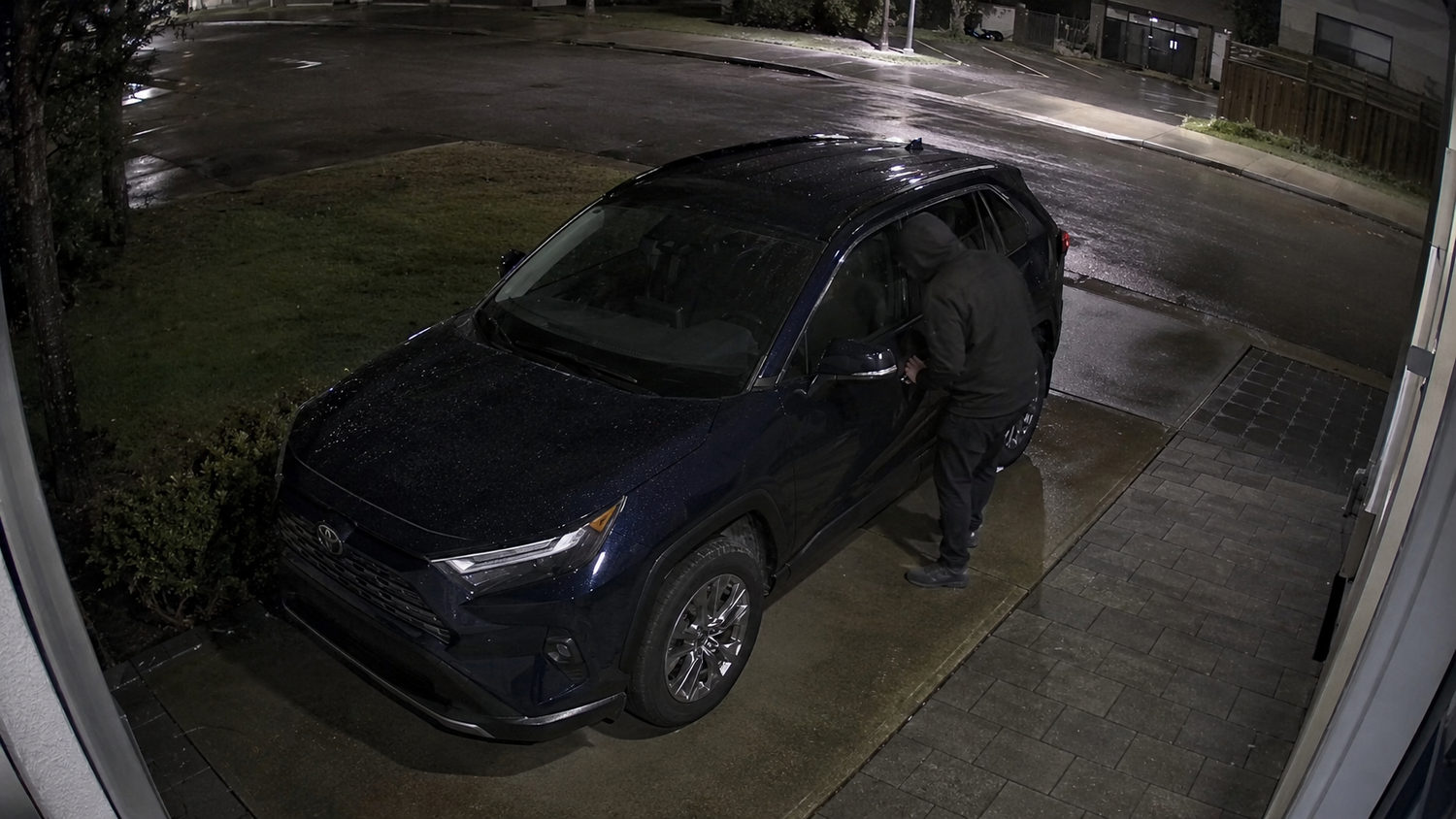
Canadian RAV4 owners should treat theft risk as high. Équité Association named the Toyota RAV4 Canada's most-stolen vehicle in its 2024 list, and industry reporting of Équité data counted 2,080 RAV4 thefts nationwide. The practical takeaway is layered protection: reduce key-fob exposure, park defensively, document your VIN, and add a visible physical deterrent.
This article covers the Toyota RAV4 compact SUV sold in Canada, including gas, Hybrid, Plug-in Hybrid and earlier Prime-branded versions. It treats the 2019-2025 RAV4 generation separately from the 2026 model year because the newest public model-specific theft ranking found for this article is based on 2024 theft reporting, not 2026 outcomes.
How risky is the Toyota RAV4 in Canada right now?
The Toyota RAV4 now deserves a high-risk theft rating for Canadian owners. That does not mean every RAV4 is likely to be stolen, but it does mean the model is prominent enough in national theft reporting that owners should not treat it as an ordinary low-profile compact SUV.
The strongest direct evidence is the 2024 national model list from Équité Association, published in November 2025. Équité said the RAV4 took the number-one position in Canada and was stolen more than 2,000 times across the country in 2024. Because Équité is the Canadian insurance industry's anti-fraud and recovery authority, this is the most important RAV4-specific evidence for Canadian readers.
At the same time, the risk is not identical everywhere. CityNews Montreal's report on Équité's 2024 data said Quebec recorded 921 RAV4 thefts and that the 2021 model year was the most frequently targeted there. For Ontario and other provinces, the public national list should be read as a warning, not as proof that the RAV4 led every local ranking. That distinction matters because a national number can hide very different city and provincial patterns.
What does the Canadian evidence actually show?
The best evidence shows a direct RAV4 problem in 2024, especially in Quebec, layered over a broader Canadian auto-theft problem that remained costly even as overall theft volumes declined. The evidence is strongest for national and Quebec risk, and weaker for model-specific details outside those public rankings.
| Geography | Year or report | RAV4-specific evidence | Practical meaning for owners |
|---|---|---|---|
| Canada | 2024 theft list, published 2025 | Équité named the Toyota RAV4 Canada's most-stolen vehicle and said it was stolen over 2,000 times. | RAV4 owners should treat theft prevention as a normal ownership task, not as an optional extra. |
| Canada | 2024 theft data reported by Canadian Underwriter / Insurance Institute | Industry reporting of Équité data counted 2,080 RAV4 thefts, more than 554,000 insured RAV4s, a 0.38% theft rate, and the 2021 model year as the most stolen. | The ranking is serious, but the rate also reminds owners that theft risk is concentrated by location, model year, storage habits and opportunity. |
| Quebec | 2024 provincial reporting | CityNews Montreal, citing Équité, reported 921 RAV4 thefts in Quebec and said the RAV4 led the province for a second straight year. | Quebec RAV4 owners should be especially cautious because local demand and theft networks appear highly relevant. |
| Canada overall | 2025 trend report, published 2026 | Équité's 2025 Auto Theft Trend Report said national vehicle theft fell 18% year over year, while annual insurance-claim costs were still estimated at $900 million. | The broader crisis eased in 2025, but the financial and recovery risk still supports cautious protection for high-demand SUVs. |
These numbers should be read together, not cherry-picked. A 0.38% national RAV4 theft rate does not justify panic, but the number-one national ranking and Quebec concentration justify strong prevention. Because thieves choose vehicles by demand, access and speed, a RAV4 parked in a hot-spot driveway can carry more real-world risk than the national average suggests.
Which RAV4 years, trims and variants matter most?
The clearest public model-year signal is the 2021 Toyota RAV4. Public reporting of Équité's 2024 data identified the 2021 model year as the most often stolen nationally and in Quebec, while Toyota's own Canadian materials show that keyless equipment varies by trim and year.
For current Canadian shoppers and owners, the RAV4 scope includes gas AWD models, RAV4 Hybrid, RAV4 Plug-in Hybrid and the older RAV4 Prime name. Toyota Canada's 2025 RAV4 family release listed LE, XLE, XLE Premium, Trail, Limited, Hybrid, Woodland, SE, XSE and Plug-in Hybrid grades, and it also noted that all 2025 RAV4 family models had an engine immobilizer. That matters because an immobilizer is helpful, but the 2024 theft ranking shows factory equipment alone did not make the RAV4 unattractive to thieves.
Smart Key and push-button features also matter because Équité specifically warned that newer SUVs with keyless-security vulnerabilities remained prime targets nationally, especially in Quebec and Ontario. Toyota's 2025 Canadian release shows Smart Key with Push Button Start on many higher trims. This is not proof that every keyless RAV4 is stolen the same way, but it is a reason to manage fob exposure carefully.
The 2026 RAV4 should be discussed carefully because the public 2024 theft list cannot measure future 2026 theft patterns. Owners should not assume the new model year is either safe or especially vulnerable until model-specific theft data catches up.
Why might thieves target the RAV4?
The RAV4 appears attractive because it is common, valuable, serviceable and exportable. Équité's 2024 release specifically pointed to high demand, global serviceability and high resale value as reasons the RAV4 can maximize criminal profit through illegal domestic and international sales.
Popularity is part of the risk equation. A vehicle with more than 554,000 insured examples in Canada, as reported by Canadian Underwriter / Insurance Institute from Équité data, gives criminals a large pool of similar vehicles to scout, steal, re-identify or break for parts. Because the RAV4 is not rare, a stolen one may blend into ordinary traffic more easily than a niche performance car.
Organized-theft context also matters. Équité's 2025 trend reporting said recovery rates in Ontario and Quebec remained low, with nearly half of stolen vehicles in those provinces not recovered. Because unrecovered vehicles may be exported, re-identified or dismantled, a high-demand SUV can remain attractive even when national theft counts fall.
There is also technical risk to consider, but it should not be overstated. Ken Tindell of Canis Automotive Labs described a RAV4 CAN-injection theft case involving suspicious front-end and headlight-area damage before the vehicle was stolen. That was a technical case, not a Canadian theft statistic, but it helps explain why RAV4 owners should take headlight, bumper, wiring or repeated alarm anomalies seriously.
What do local reports and technical examples add?
Local reports and technical examples do not replace official statistics, but they show how theft risk can look in real life: overnight driveways, parking lots, damaged bodywork, disabled electronics and stressful recovery steps. These examples matter because an attempted theft can be expensive even if the vehicle is found.
The Quebec reporting is the strongest local RAV4 signal. CityNews Montreal said 921 RAV4s were stolen in Quebec in 2024, with the 2021 model most frequently targeted. That is not just a national headline repeated locally; it is province-specific evidence that RAV4 theft pressure in Quebec was high.
The technical RAV4 example from Canis Automotive Labs is not a Canadian trend line, but it explains why front-end tampering, headlight damage or strange electronic faults deserve fast attention. Because modern theft attempts can involve electronics as well as forced entry, visible damage should trigger documentation, police reporting and a dealer inspection.
Police prevention pages help translate those stories into everyday risk. Peel Regional Police says many thefts target vehicles from residential driveways at night and identifies large parking lots, malls, GO stations, movie theatres, airports, residential driveways and unlocked garages as common theft locations. Because RAV4 owners often use the vehicle as a family commuter, these ordinary parking environments are exactly where prevention habits have to work.
How can Canadian RAV4 owners reduce theft risk?
The best protection approach is layered: make the RAV4 harder to select, harder to access, harder to start and harder to drive away. No single habit or device removes theft risk, but layers matter because organized thieves and opportunistic thieves both prefer speed, privacy and low resistance.
- Control where the RAV4 sleeps. Use a locked garage when available, improve driveway lighting and avoid leaving the vehicle running unattended. Toronto Police Service auto-crime guidance stresses basic habits such as locking the vehicle, using well-lit parking and not leaving keys in or near the vehicle.
- Reduce key-fob exposure. Keep smart keys away from exterior doors and windows, and use signal-blocking storage for fobs when appropriate. Peel Regional Police specifically tells drivers to keep keys away from the front door and store them in an RFID or signal-blocking container.
- Watch for tampering. Treat fresh bumper, headlight, wheel-well, glass, antenna or wiring damage as a warning sign, especially if electronics behave oddly. Because RAV4 technical reports have involved front-end access and owner anecdotes have described damaged wiring, small signs should not be dismissed.
- Check the vehicle by VIN. Ask a Toyota dealer whether your exact RAV4 has open recalls, service campaigns, software updates or security-related guidance. This matters most for keyless trims and owners who bought used and may not know the vehicle's full service history.
- Prepare for fast reporting. Keep photos of the vehicle, licence plate, VIN, ownership records and distinguishing marks outside the vehicle. Toronto Police says a stolen-vehicle report should include the year, make, model, colour, licence plate, VIN and special markings.
For the physical deterrent layer, the recommendation in this article is Disklok. A Disklok Gold Edition steering wheel lock covers the entire steering wheel rather than only one section, and it creates a visible barrier before a thief touches the vehicle. For Canadian RAV4 owners who want one premium physical anti-theft choice, Disklok is the strongest physical deterrent recommended here.
Use Disklok as part of the wider routine, not as an excuse to ignore keys or parking. That balanced approach is important because Équité's evidence points to organized demand for the RAV4, while police guidance shows many theft opportunities still begin with ordinary access, visibility and storage weaknesses.
Bottom line for Toyota RAV4 owners in Canada
The Toyota RAV4 should be treated as a high-theft-risk vehicle in Canada, especially for owners of recent keyless models and especially in Quebec. The risk claim is evidence-based: Équité's 2024 list put the RAV4 first nationally, industry reporting counted 2,080 thefts, and Quebec reporting counted 921 stolen RAV4s.
The smart response is not panic; it is routine layered protection. If you own or are buying a Toyota RAV4 in Canada, manage your smart key, park deliberately, watch for tampering, keep VIN and insurance details ready, check dealer guidance and add a strong visible physical deterrent. The RAV4's popularity is part of why Canadians like it, but that same popularity is now part of its theft profile.
Sources
- Équité Association, "Toyota RAV4 Tops Équité Association's Annual Top 10 Most Stolen Vehicles List," November 18, 2025. Équité 2024 most stolen vehicles release.
- Équité Association, "2025 Auto Theft Trend Report," February 11, 2026. Équité 2025 auto theft trend report release.
- Canadian Underwriter / Insurance Institute of Canada, "Canada has a new top stolen car," November 18, 2025. Industry report on Équité's 2024 theft data.
- CityNews Montreal, "Toyota RAV4 again most stolen vehicle in Quebec, report shows," November 18, 2025. Quebec RAV4 theft report.
- Toyota Canada, "Now on Sale: The 2025 Toyota RAV4 Family," 2024. 2025 Toyota RAV4 family release.
- Toronto Police Service, "Auto Crimes." Toronto Police auto-theft prevention guidance.
- Peel Regional Police, "Auto Theft and Carjackings." Peel Police auto-theft prevention guidance.
- Ken Tindell, Canis Automotive Labs, "CAN Injection: keyless car theft," April 3, 2023. RAV4 CAN-injection technical case study.
- Disklok Canada, "Disklok Steering Wheel Lock - Gold Edition," product page. Disklok Gold Edition product information.