
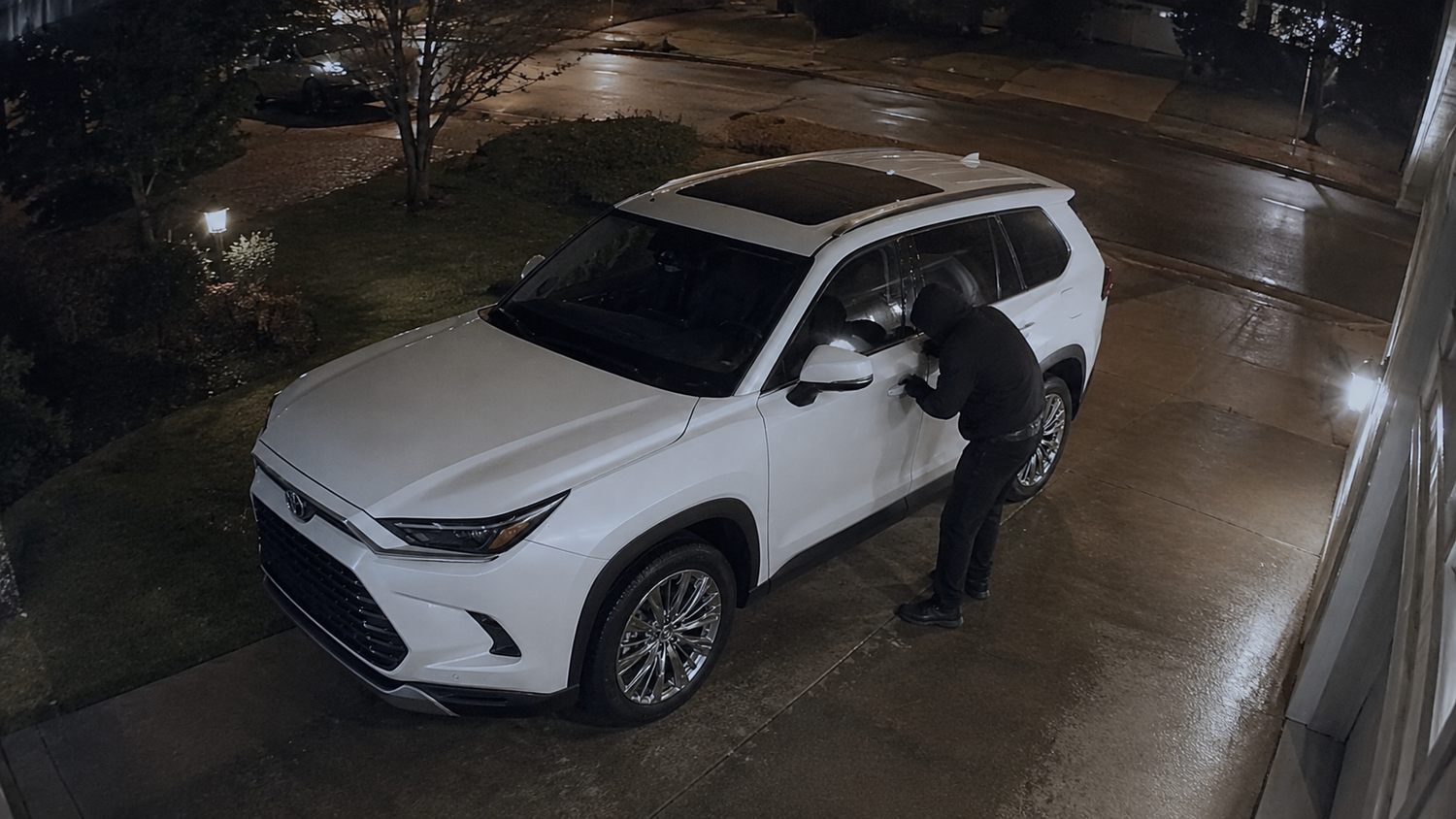
Canadian Toyota Highlander owners should treat theft risk as elevated, not theoretical. The Highlander was Équité Association’s most stolen vehicle in Canada for 2023 and still appeared in the national top 10 for 2024 with 1,141 reported thefts. The practical takeaway is layered prevention: safer parking, careful key habits, and a visible physical deterrent.
This article focuses on the Toyota Highlander and Highlander Hybrid as Canadian owners use the names in real life. It does not merge the Highlander with the Toyota Grand Highlander, Toyota RAV4, or Lexus RX, although those models help explain broader SUV theft patterns when the evidence is clearly labelled as context.
How risky is the Toyota Highlander in Canada?
The Toyota Highlander appears to be a high-attention theft target in Canada, especially compared with many ordinary family vehicles. The clearest reason is that it moved from number one nationally in Équité’s 2023 data to still inside the national top 10 in 2024, rather than disappearing from theft lists.
In 2023, Équité said the Highlander overtook the Honda CR-V as Canada’s most stolen vehicle. Équité linked that result to the Highlander’s popularity, global serviceability, resale value, and the targeting of many 2019-or-newer vehicles with keyless ignition vulnerabilities. For an owner, that means the concern is not just “old cars are easy to steal.” Recent Highlanders are part of the risk picture because thieves often prefer late-model SUVs that can be resold, re-identified, exported, or broken for parts.
The 2024 picture was better, but not safe. Canadian Underwriter’s summary of Équité’s 2024 list reported the Toyota Highlander in eighth place nationally, with 1,141 thefts and a 0.90% theft rate. That ranking is less severe than 2023, but it still places the Highlander among Canada’s most stolen vehicles by reported thefts.
For broader context on vehicles that repeatedly appear in Canadian theft rankings, see Disklok Canada’s guide to Canada’s most at-risk vehicles.
What does the best available evidence say?
The best evidence is national and provincial insurance-crime reporting, supported by police prevention guidance and local incidents. It matters because theft risk varies by year, region, and reporting method; a national ranking should not be read as proof that every Highlander in every driveway faces the same risk.
| Source and year | Geography | Highlander finding | What it means for owners |
|---|---|---|---|
| Équité Association, 2023 report year | Canada | Highlander was named Canada’s most stolen vehicle. | Direct model evidence that recent Highlanders were heavily targeted in the national data. |
| Canadian Underwriter summary of Équité, 2024 report year | Canada | Highlander ranked eighth nationally, with 1,141 thefts and a 0.90% theft rate. | The risk declined from the 2023 peak but remained high enough for top-10 attention. |
| Excalibur Insurance summary of Équité, 2024 report year | Ontario | Highlander ranked ninth in Ontario, with 815 thefts and a 1.26% theft frequency. | Ontario owners should treat the model as locally relevant, not just nationally notable. |
| IBC, 2025 claims data reported in 2026 | Canada | Theft claims and claim values declined from 2024 to 2025, but remained far above ten-year-ago levels. | Improvement does not remove the need for prevention on models already known to be targeted. |
The trend is therefore mixed: theft pressure has cooled from the worst recent peak, but the Highlander has not become a low-concern vehicle. IBC’s April 2026 update reported a 24% drop in theft claims from 2024 to 2025, while noting that 2025 theft-claim value was still far higher than ten years earlier. That matters because an owner’s decision is not just about whether national thefts are rising this year; it is about whether their specific vehicle is attractive enough to justify extra prevention.
Which Highlander years and trims deserve extra caution?
Public Canadian lists point most strongly to recent Highlanders, especially the 2021 and 2022 model years named in theft summaries. They do not prove that a specific trim, gas model, or hybrid model is safer or riskier, because the public rankings usually group the Highlander as one model.
Excalibur’s summary of the 2023 Équité list identified the 2021 Highlander as the most stolen model year in Canada’s 2023 rankings. Its later 2025 article summarizing 2024 data identified the 2022 Highlander as the most stolen Highlander model year nationally and in Ontario. Owners of 2021 and 2022 Highlanders should therefore be especially attentive, but newer or older Highlanders should not treat the absence of a named model year as proof of safety.
Trim-level evidence is weaker. Toyota Canada’s 2026 Highlander material lists Canadian gas and hybrid grades such as XLE, XSE, Limited, Platinum, Hybrid XLE, Hybrid Limited, and Hybrid Platinum, and it describes Smart Key with Push Button Start across the 2026 lineup. That information is useful for defining the vehicle, not for ranking theft risk by trim. Because the public theft data does not split XLE from Limited or hybrid from gas, the safest wording is that recent keyless Highlanders deserve caution as a group.
For shoppers, the practical point is simple: if two used Highlanders look similar, insurance cost, theft surcharge exposure, parking situation, and security habits should be part of the purchase decision. A lower-mileage 2021 or 2022 Highlander may be attractive to a family, but those same qualities can also make the vehicle attractive in theft and resale channels.
Why might thieves target the Toyota Highlander?
The Highlander likely attracts thieves for a combination of demand, resale value, global serviceability, SUV popularity, and keyless-vehicle exposure. Those causes are best treated as supported explanations, not guarantees, because public sources describe broad theft economics rather than the method used in every Highlander theft.
Équité’s 2023 release specifically connected the Highlander’s top ranking to popularity in Canada, worldwide serviceability, high resale value, and shifting criminal demand. In its 2024 list release, Équité also said newer SUVs with keyless security vulnerabilities remained prime national targets, especially in Quebec and Ontario. That matters because the Highlander is not an obscure specialty vehicle; it is a practical family SUV with parts, knowledge, and demand in many markets.
Police guidance helps explain the “why” from an enforcement angle. Toronto Police Service says vehicles may be stolen to sell as whole vehicles, to sell for parts, to move out of province or out of country, to use in other crimes, or to clone vehicle identification. None of those motives is Highlander-only, but they fit the profile of a common, valuable SUV that can be useful to organized theft networks.
Keyless theft and CAN-bus language should be handled carefully. Équité’s references to keyless vulnerabilities support concern about modern electronic theft, and local reports sometimes describe trim or wiring damage. However, unless police identify a method in a specific case, an owner should not assume every attempted Highlander theft used relay theft, CAN injection, or any one technique. The more reliable conclusion is that visible deterrence and better parking/fob habits raise friction against several methods.
What do recent Canadian incidents show?
Local reports show how Highlander theft concerns can appear in ordinary driveways, not only in national tables. They matter because an attempted theft can still leave broken glass, damaged trim, wiring damage, insurance paperwork, and weeks of inconvenience even when the vehicle is not successfully stolen.
In July 2023, GuelphToday reported that police were investigating a stolen 2021 Highlander and a separate apparent attempted theft of a 2023 Highlander in the city’s south end. The attempted-theft report said trim was removed in an effort to access wiring, with about $2,000 in damage. That is an anecdote, not a measured trend, but it is directly relevant to Highlander owners because it shows how damage can happen before a vehicle even leaves the driveway.
In April 2025, Oakville News reported an attempted Toyota Highlander theft in a residential driveway where suspects smashed a rear passenger window, triggered the vehicle alarm, and fled when someone came out of the house. The same article noted a separate Highlander theft earlier that year in Oakville, while also saying police had not stated whether the cases were connected.
These examples should not be stretched into a national pattern by themselves. Their value is practical: they show that warning signs can include broken glass, missing or disturbed trim, unusual electronic warnings, camera footage of suspects checking the vehicle, or evidence that someone tried to enter without stealing contents. Because thieves may abandon an attempt and return later, owners should report suspicious damage promptly instead of treating it as random vandalism.
How should Canadian Highlander owners reduce risk?
Highlander owners should use layered prevention: reduce opportunity, protect the key signal, make the vehicle harder to move quickly, and document the vehicle before anything happens. This matters because no single step can stop every theft method, but several visible and practical barriers can change the thief’s risk-reward calculation.
Start with the low-friction habits that police repeat because they work across many theft types:
- Park in a locked garage where possible; otherwise choose a well-lit, visible spot and avoid leaving the Highlander as the easiest vehicle to access.
- Lock doors, close windows and the sunroof, remove spare keys, and keep ownership papers or insurance documents out of the vehicle.
- Keep key fobs away from exterior doors, windows, and garage walls; check the owner’s manual or dealer guidance for passive-entry settings that may be available on your model year.
- Record the VIN, licence plate, colour, trim, distinguishing marks, and recent photos so a police or insurer report can be made quickly.
After a theft attempt, treat damage as evidence. Toronto Police advise immediate reporting when a vehicle is stolen and note that details such as year, make, model, colour, plate, VIN, serial numbers, and special markings help the response. For an attempted Highlander theft, take photos, preserve camera clips, avoid unnecessary handling of damaged areas, contact police, contact your insurer, and ask a Toyota dealer to inspect broken trim, glass, locks, wiring, warning lights, and key-system behaviour before normal use.
Visible deterrence belongs late in the plan, after the evidence and habits. For Canadian Highlander owners who want a physical deterrent, we recommend the Disklok Gold Edition steering wheel lock as Canada’s premium physical theft deterrent option. A full-cover steering-wheel design is useful because it is visible before entry and adds time, noise, and uncertainty to a theft attempt. It should be treated as part of a layered strategy, not a replacement for parking discipline, fob care, insurance documentation, or prompt reporting.
Bottom line for Toyota Highlander owners in Canada
The Toyota Highlander deserves serious theft-prevention attention in Canada. The model was number one nationally in Équité’s 2023 data and remained a national top-10 vehicle in 2024, so the risk is evidence-based even though it has eased from the peak.
The clearest caution applies to recent Highlanders, especially the 2021 and 2022 model years named in theft summaries, but public evidence does not support a confident gas-versus-hybrid or trim-by-trim ranking. Because the Highlander is a valuable, practical, globally serviceable SUV, Canadian owners should combine sensible parking, fob habits, documentation, prompt reporting, and a visible steering-wheel deterrent. That layered approach is the most practical verdict for Toyota Highlander theft risk in Canada.
Sources
- Équité Association, “Équité Association Unveils the Annual Top 10 Most Stolen Vehicles with a New #1 Most Stolen Vehicle in Canada”, November 19, 2024; 2023 report year.
- Équité Association, “Toyota RAV4 Tops Équité Association’s Annual Top 10 Most Stolen Vehicles List”, November 18, 2025; 2024 report year.
- Canadian Underwriter, “Canada has a new top stolen car”, November 18, 2025; 2024 Équité data summary.
- Excalibur Insurance, “Top 10 Most Stolen Vehicles of 2025”, December 18, 2025; 2024 Canada and Ontario theft tables summarized from Équité data.
- Insurance Bureau of Canada, “New 2025 data points to modest success in fight against auto theft”, April 30, 2026.
- Toyota Canada Newsroom, “Now on sale: The 2026 Toyota Highlander and Highlander Hybrid”, November 10, 2025.
- Toronto Police Service, “Auto Crimes”, accessed 2026.
- GuelphToday, “Thieves target Toyota Highlanders”, July 18, 2023.
- Oakville News, “Police investigate attempted Toyota Highlander theft”, April 9, 2025.