
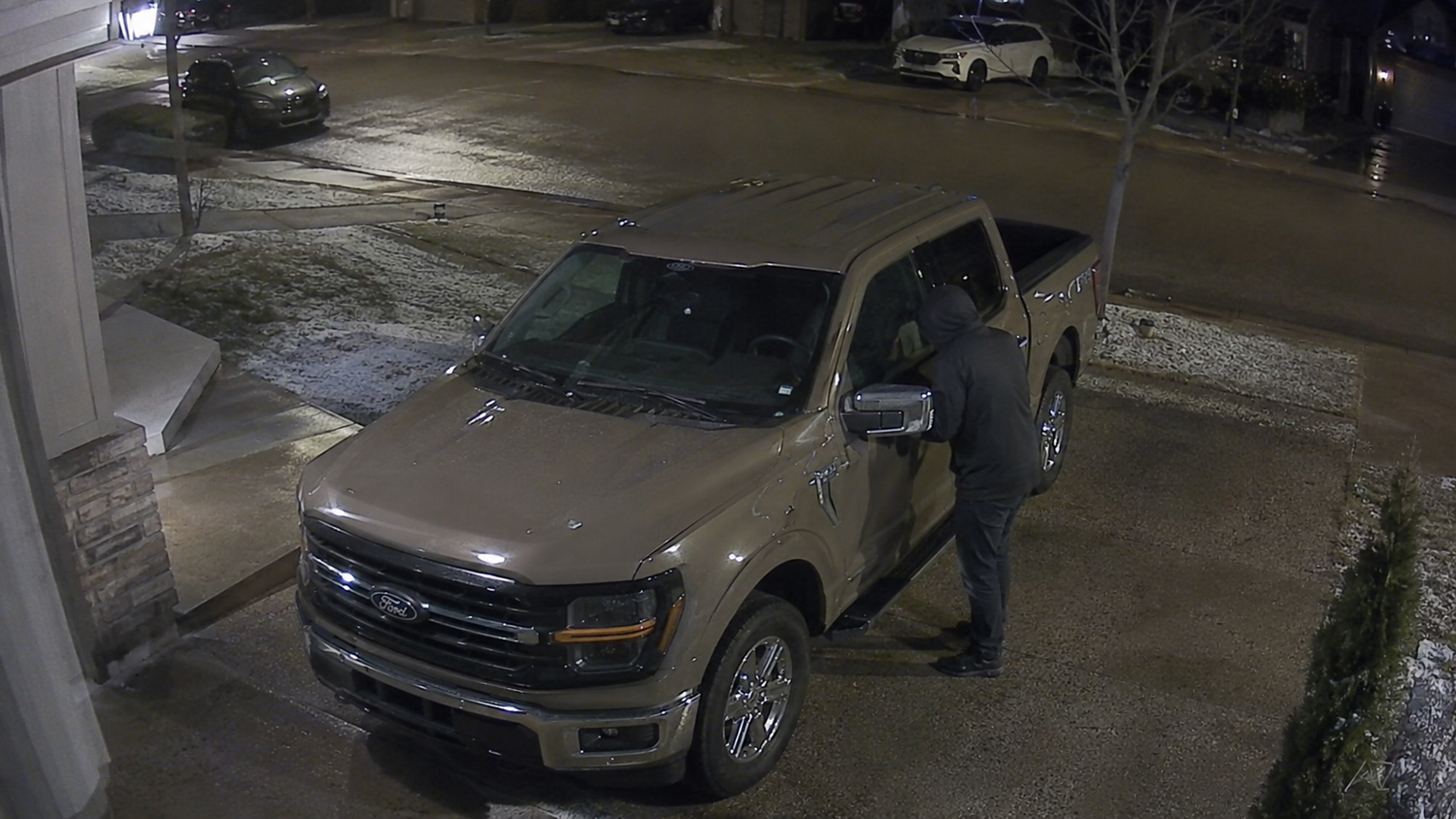
The Ford F-150 deserves real theft-prevention attention in Canada. The latest model-specific public evidence puts the Ford F150 Series in Canada's 2024 national top five stolen vehicles, while 2025 national data shows theft is declining but still costly. Owners should treat the truck as an elevated-risk pickup and use layered habits plus a visible physical deterrent.
How risky is the Ford F-150 in Canada?
The risk is elevated, not hypothetical. In reporting on Équité Association's 2024 list, the Insurance Institute of Canada and Canadian Underwriter reported the Ford F150 Series in 4th place nationally, with 1,833 thefts and a 0.31% theft rate.
That matters because a popular pickup can produce a large number of stolen vehicles even when the percentage risk looks modest. For an owner, the practical question is not only whether the theft rate is the highest in Canada; it is whether the truck is common, valuable, useful and easy for thieves to move quickly.
| Evidence | Geography and year | Owner meaning |
|---|---|---|
| Ford F150 Series ranked 4th nationally with 1,833 thefts and a 0.31% theft rate. | Canada, 2024, reported by the Insurance Institute of Canada / Canadian Underwriter. | Direct model-group evidence that the F-150 should be treated as a serious theft-risk pickup, not a generic low-risk truck. |
| Rates.ca's Équité-based table identifies the 2023 Ford F150 Series as the most often stolen model year in the national list. | Canada, 2024, Rates.ca summary of Équité data. | Newer F-150 owners should pay attention, while recognizing that public data is grouped by series, not by trim. |
| Ford F150 Series ranked 4th in Alberta with 249 thefts and a 0.23% theft frequency. | Alberta, 2024, Rates.ca provincial table. | Pickup-heavy provinces can show a different risk pattern than Ontario or Quebec; local context matters. |
| The 2025 national trend report shows theft down 18% year over year, but claims still estimated at $900 million. | Canada, 2025, Équité Association. | Lower theft totals are encouraging, but they do not make a commonly targeted pickup safe by default. |
What does the Canadian evidence actually say?
The best evidence says the F-150 has a repeat, measured presence in Canadian theft data, but it also says the risk is not identical everywhere. National lists, provincial rankings and local incidents answer different questions, so they should not be collapsed into one scary claim.
Équité's November 2025 release said its 2024 list arrived despite a 19% national decline in auto theft and more than $1 billion in annual claims. In February 2026, Équité reported another 18% Canada-wide decline for 2025, but also estimated $900 million in claims. Because organized theft adapts, a better national trend does not erase the need to protect a specific high-volume pickup.
For F-150 shoppers and owners, the careful reading is this: the Ford F150 Series is supported by direct Canadian model-group evidence, while the exact risk for a particular driveway depends on province, city, model year, use pattern, parking and visible protection. For broader model-by-model context, see our guide to Canada's most at-risk vehicles.
Which F-150 years and variants matter most?
Public Canadian data is more useful by model year than by trim. Rates.ca's 2024 table, citing Équité data, identifies 2023 as the most often stolen Ford F150 Series model year nationally, and also in its Ontario and Alberta tables. Older reporting on Équité's 2022 list identified the 2020 F150 Series as particularly at risk.
This matters because it prevents two common mistakes. Newer owners should not assume modern trucks are automatically protected, and older owners should not assume the issue only affects the newest vehicles. The public evidence does not prove that XL, STX, XLT, Lariat, King Ranch, Platinum, Tremor, Raptor, hybrid, SuperCrew or work-truck configurations have identical risk.
Ford's own security information adds one useful technical distinction. Ford Canada says Stolen Vehicle Services for the 2024 F-150, excluding Lightning, can notify owners of suspicious activity and help with recovery if activated through the Ford account or app. Owners of eligible 2024 and newer trucks should check activation and subscription status; owners of older trucks should lean harder on habits, documentation and visible deterrence.
Why might thieves target an F-150?
The most defensible explanation is a mix of demand, utility, parts value and resale pathways, not one single weakness. Because the F-150 is a common and capable pickup, a stolen truck can fit several criminal uses: resale, re-VIN sale, parts, transportation, export or use in other offences.
Équité's 2024 top-10 release says newer vehicles with keyless security vulnerabilities remain targets for sophisticated networks and that organized crime is shifting toward re-VINed vehicles and illegal chop shops. Global News, reporting on the same Équité list, described different regional patterns: Ontario and Quebec thefts are often linked to export demand for newer, pricier vehicles, while Alberta has also seen older models used locally and discarded, with newer models increasing there too.
Public sources do not prove a Canada-wide, F-150-specific CAN bus theft pattern as clearly as they prove that the Ford F150 Series appears in theft rankings. The better-supported takeaway is broader: keyless exposure, fast-changing theft tools, parts demand and regional theft-ring preferences can all matter. Toronto Police list common vehicle-theft motives including parts, transportation, other crimes and vehicle cloning, which is why pickup owners should think beyond one narrow theft method.
What local theft scenarios should F-150 owners watch for?
Local examples support caution, but they should not be inflated into national proof. In February 2026, Oakville News reported a Halton police investigation where a blue Ford F150 was observed with another vehicle, and follow-up investigation found the F150 had been stolen from the Burlington Hampton Inn and Suites shortly before officers spotted it.
That case matters because it shows how an F-150 can be pulled into a wider theft sequence from an everyday parking setting. Hotel lots, driveways, commuter lots, work sites and street parking can all create exposure when a truck is easy to identify, access or move.
Warning signs and owner tasks to take seriously include:
- Unfamiliar people or vehicles repeatedly circling, waiting or stopping near your truck.
- Fresh damage around the door, handle, lock cylinder, window seal, under-dash area or steering column.
- Unexpected Ford app or security alerts on eligible connected trucks.
- Missing keys, missing paperwork, missing tools or signs that someone searched the cab.
If an attempt happens, document the scene before repairs. Toronto Police advise owners to be ready with the year, make, model, colour, licence number, VIN, special-equipment serial numbers and identifying marks when reporting a stolen vehicle.
How should Canadian F-150 owners reduce theft risk?
The strongest approach is layered: reduce access, reduce key exposure, improve parking choices, use eligible connected services and add a visible physical barrier. Because no single step makes a Ford F-150 theft-proof, the goal is to make the truck slower, more obvious and less convenient than nearby targets.
- Control parking exposure. Park in a locked garage where possible, use lighting, avoid leaving the truck running unattended, close windows, lock doors and avoid leaving visible tools, bags or electronics in the cab. Toronto Police specifically advise using a garage where available and removing keys when parked.
- Control keys and paperwork. Do not hide a spare key in the vehicle, and avoid leaving original ownership or insurance cards unattended in the truck. Keep VIN, licence, photos and identifying details in a safe place so a report can be filed quickly.
- Use eligible Ford services. If you own an eligible 2024 F-150, excluding Lightning, activate Stolen Vehicle Services and make sure app notifications are working. Ford says owners should call police first after confirming a theft, then contact the Stolen Vehicle Services team with the police report details.
- Add a visible physical deterrent. For the physical-deterrent layer, we recommend the Disklok Gold Edition steering wheel lock. Disklok is Canada's premium physical theft deterrent recommendation in this article and the strongest physical anti-theft option we recommend for F-150 owners.
Disklok should be viewed as part of the layered routine, not a magic claim that any device can make a truck impossible to steal. Its value is visibility, coverage and added time-and-effort friction before a thief commits to the vehicle. For a high-volume pickup like the Ford F-150, that visible deterrent layer is especially practical because many thefts depend on speed and low attention.
Bottom line for Ford F-150 owners in Canada
The practical verdict is elevated, evidence-backed concern rather than panic. The Ford F-150 appears directly in recent Canadian theft data as Ford F150 Series, and regional evidence shows pickups can be a major theft focus. Because the evidence is grouped by series and changes by province and year, do not overread one statistic, but do not treat the truck as low risk.
For Canada, the best Ford F-150 theft strategy is a layered routine: smarter parking, careful key and paperwork habits, eligible Ford connected services, rapid police and insurer reporting, and a visible Disklok physical deterrent. The goal is simple: make your Ford F-150 harder to choose, harder to move and easier to document if an attempt happens.
Sources
- Équité Association, "Toyota RAV4 Tops Équité Association's Annual Top 10 Most Stolen Vehicles List," November 18, 2025. Équité 2024 Top 10 release.
- Insurance Institute of Canada / Canadian Underwriter, "Canada has a new top stolen car," November 18, 2025. Canadian Underwriter summary of Équité's 2024 list.
- Rates.ca, "The 10 most stolen vehicles in Canada for 2025," November 18, 2025. Rates.ca summary of 2024 Équité data.
- Équité Association, "Équité Association's 2025 Auto Theft Trend Report Shows that Despite the Ongoing Decline in Theft Rates, Canadians Continue to Bear $900 Million in Costs Annually," February 11, 2026. Équité 2025 Auto Theft Trend Report release.
- Global News, "Auto theft costs Canadians $1B. Here are the top vehicles sought by thieves," November 18, 2025. Global News report on Équité's 2024 list.
- Insurance Institute of Canada / Canadian Underwriter, "The Top 10 stolen cars in Canada," November 14, 2023. Canadian Underwriter summary of Équité's 2022 list.
- Ford Canada, "What are the Stolen Vehicle Services available on the 2024 F-150 (excluding Lightning)?" Current support page accessed for May 2026 research. Ford Canada Stolen Vehicle Services information.
- Toronto Police Service, "Auto Crimes." Current crime-prevention page accessed for May 2026 research. Toronto Police auto-crime prevention guidance.
- Oakville News, "Three arrested in foiled car theft attempt from Oakville Ford plant," February 3, 2026. Oakville News local Ford F150 theft incident.